The History of Baabdat
- The geography of Baabdat
- The name of Baabdat
- The origin of Baabdat and the reason of the concentration of the population and its expansion
- The confessions and temples of Baabdat
- Industry and agriculture in Baabdat
- Tourism in Baabdat
The geography of Baabdat
The location and topography of Baabdat
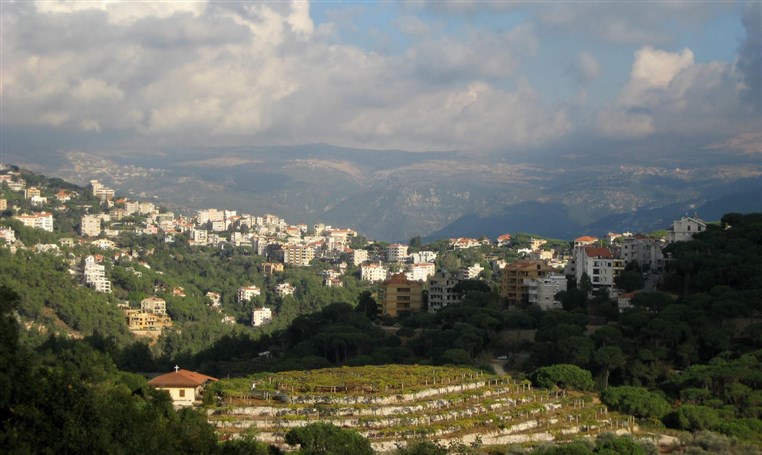
Baabdat is located in the center of Lebanon in the northern Maten province as an average of 800 meters above sea level and around 22 kilometers away from the eastern part of the capital Beirut. It is formed of small hills and downhills whose topographic relieves vary between 400 meters at the southern border at the Jaamany river floor (a branch of the Beirut River) and 1200 meters at the northern border.
The surface of Baabdat
The approximate surface of Baabdat is 5 123 808 square meters.
The soil, rocks and woodlands of Baabdat
The soil of Baabdat is red and dark and the rocks are calcareous, solid and appropriate for construction. There are sandy soil appropriate for planting trees. The soil of Baabdat is covered with pine and oak trees…
The climate of Baabdat
Baabdat has a Mediterranean mountain weather that is relatively mild and a healthy dry wind. The temperatures vary between 10 degrees in the winter and 30 in the summer.
Water resources
There are many springs in Baabdat. The most important is the Aaraar spring that provided 85% of the irrigation water and its amount varied between 100 and 300 cubic meters per day. The spring is divided into three parts that are Kissmallah, Behsasah and Qabu. Its advantages are big and it always satisfied domestic, agricultural and industrial needs and silk factories. It has a special distribution system counting on the number of males in the principal families and the means of living within a specific household. There are other springs such as Ain al-Daia, Ain al-Jura, Ain al-Hakla, Nabeh el-Fuwar, Ain Beit Ghandour and Ain Asfeyla but they have run dry and their use decreased.
The name of Baabdat
Because the name is the identity, a research was necessary to find the origin of the name of Baabdat and many opinions were found:
- Some said the name originated from the aramaean language “beit abdoto” which means in arabic the “house of worship”. The village was named like this, because of the temple, the ancients built in it and to which a lot of males and females sacrificed themselves. The place was called “beit al eabada” or “beit al-abdat” and the denomination became later Baabdat.
- Some said the name goes to “beit al abidat”, the house of the workers, the house of the servants or the house of the slave.
- Others said the meaning of the name is “ab el abidat” the father of the worshippers. A man came to Baabdat and had five daughters who made a vow of chastity. He built a temple for them in the name of Saint Méma known as “beit al aabidat” i.e. the house of the worshippers.
The origin of Baabdat and the reason of the concentration of the population and its expansion
Eras, groups, communities and religions followed in Baabdat:
Cananeans and Arameans
It is said that Cananeans and Arameans were the first to live in Baabdat because there are ruins of their temple or place of worship in the gallery of the Aaraar spring which is the main spring of the village.
Phoenicians
The presence of an old tower with a view on the Jaamany river, proves the phoenicians were there but it was demolished and its stones were used to build a part of the Saint George church in 1660.
Romans
Researchers base the presence of romans in Baabdat on the fact that they pulled the water of the Araar spring through a special channel to their temple in the area known today as “Deir el-Kalaa” in the village of Beit Mery which is 9 kilometers away. The channel crossed Baabdati places such as Roueiseh, al-Qantara and al-Qasha. There are also features of roman engineering and architecture in the Qabwa, one of the branches of the Aaraar spring.
Unitarian Druze
A group of druze lived in Baabdat (it’s a religious group belonging to islam) who came to cooperate with some princes in preventing the invasion of the french crusaders from the coasts of Beirut and the capital of the south, Saida. They entered Baabdat, practiced tyranny on the population, burnt the land and invested it.
Memluks, Kurds and Turkmen
At the end of the 13th generation, the Druze owned all the lands of Baabdat. After the attacks of the Memluks in 1305, the province of Kesrouan was emptied from Christians, Druze and Shiites. They spread in the north and south including the people of Baabdat. Their houses and properties were invaded by Kurds and Turkmen in the north until the Al-Khazen Sheikhs of Kesrouan displaced them.
Christians
Baabdat was revived after the ottomans won over the Memluks in 1516. Since 1545, christian families from Jbeil and Batroun provinces came to the Maten province. Families who became a part of Baabdat arrived starting from the 16th century including: Corbani, Labaki, Safi, Zimmar, Melki, Abou Diwan, Obeid, Ghandour, Abou Heyla, Khater, Shaanine, Saleh, Hayek, Arid, Alam, Zoghbi and Sawaya.
Later, more precisely since 1920 other families that are not included in our research joined Baabdat such as: Asmar, Hajj Boutros, Shamoun, Romanos, Gemayel, Abou Jawde, Shakar, Daher, Saleh, Al-Ayya, Yammine, Hashem, Ghssoub, Ghanem, Nawfal, Nehme, Ajjour, Armenian families and others.
At the end of World War II, when the polish (from Poland) arrived to Baabdat and remained five years (1946-1950), construction improved and developed and it was modernized thus progressively transforming Baabdat into a tourism and estivation area. The selling of properties and the housing construction became active and new developed residential areas surfaced. The number of houses reached 2500 in 2008 while it didn’t exceed 145 in 1939.
The number of the population in Baabdat in the seventies was estimated at 3069 persons according to the official records. In the new statistics of 2008 the number of the population was estimated at 8000 in the winter and 15000 in the summer.
The confessions and temples of Baabdat
At the beginning and more specifically in 1890 the Maronites were a majority in Baabdat (the Maronite confession is an Eastern Catholic Christian branch subject to the authority of the Vatican and related to Saint Maroun). However, because of a civil conflict between the residents and the religious official authorities at that time, two thirds of the population of Baabdat became Protestants in 1892 and then within months became Latins. This occurred on January 6, 1893. Starting from that time, the main confessions in Baabdat were the Latin Western and the Maronite Eastern until others Christian families joined them.
As for the worship places in Baabdat, they are the following:
- The maronite Mar (Saint) Elias Church that started in 1620 as a worship place and then was transformed in September 1702 into a church.
- The maronite Mar Jeryes (George) Church built in 1660.
- The maronite Sayyidat Al-Najat (Our Lady of Deliverance) Church built in 1885.
- The latin Mar Antonios Al-Badwani (Saint Anthony of Padova) Church built in 1900.
- The greek catholic Malak Mikhaeel (The Angel Michael) Church built in 1963.
- The sanctuary of Sayyidat Al-Raja (Our Lady of Hope) built in 1955.
In addition to all these sacred places in Baabdat, there are 3 convents:
- The convent of Saint Antonios Al-Badwani for the Capuchin fathers built in 1900.
- The convent of the Sisters of Charity of Besançon built in 1913.
- The convent of the Sacrés Coeurs (Sacred Hearts) nuns built in 1991.
The number of priests and nuns from Baabdat kept rising till it reached in 2008 the total of 70 priests, 19 sisters and 25 brothers. Two of the Capuchin priests who are Leonard Melki and Tuma Saleh were the martyrs of the Turks during World War I, as they were missionaries in Turkey. Their sanctification is under study by the Vatican since 2006.
Industry and agriculture in Baabdat
The first residents of Baabdat counted on agriculture which was the backbone of their economy until the 1950s. They grew vegetables, olive trees, vineyards, berries. They also raised silkworms to manufacture silk and this industry was a main source of living for the population that built silk factories and exported its production to France in particular.
At the beginning, the Baabdatis worked in the pine and oak forests. They raised cows, sheep and other domestic animals. They used the vital Aaraar spring and the springs of the village to irrigate their cultures and satisfy their specific domestic and industrial needs… The economy in Baabdat remained based on agriculture until it moved in the fifties to the service sector such as house rental and some light industry professions, employment and freelancing… Today, agriculture doesn’t constitute more than 3% of the Baabdati economy.
Baabdat was also known for the production of grape molasses due to the abundance of different kinds of grapes in many areas. The residents built close to these vineyards grape presses carved into natural rocks. The spread of this industry is proven by the presence of 14 grape presses whose ruins of some of them still remain. Grapes weren’t only used to make molasses but also wine, raisins and arak (arak is a lebanese alcoholic drink). Oil was also extracted from olives.
Nowadays, the economic activity in Baabdat is based on some freelance professions including lawyers, doctors, engineers… in addition to modern technical services, shopping and tourism places as well as banking services and some conversion industries related to wood, welding, plastic, medicines, mechanics, aluminium etc.
Tourism in Baabdat
Before World War I, Baabdat didn’t witness any estivation in general but some Baabdatis living in Egypt or Beirut came in the summer season. Before 1938, it didn’t even have a municipality taking care of that sector. However, the housing, health and building development made it one of the first estivation villages since 1950.
The reason of the estivation development in Baabdat goes to many important factors including:
- The hospitality
- The healthy climate of Baabdat
- Its calmness in general
- Its civilized and high society people
- The provision of the needs and services for the summer visitors
- The Maten Highway that directly linked Baabdat within a few minutes to the Lebanese coast